Проводя фронтальные эксперименты, учащиеся самостоятельно наблюдают физические явления и знакомятся с процессом получения и обработки данных. Учебно-экспериментальный процесс носит обобщающий характер и помогает учащимся развивать навыки исследования, обобщения фактов и критического анализа результатов физических экспериментов. Эксперименты могут включать различные виды деятельности, направленные на достижение образовательных целей. Эксперименты различаются по цели и масштабу, как по количеству используемых инструментов, так и по сложности задачи.
Ключевые слова: фронтальные эксперименты, физические явления, устройства приборов, действие приборов, логический анализ, экспериментальные задания, естественная исследования, эмпирические данные.
Frontal experiments can be conducted for the following purposes:
- Formulating a development problem
- Studying the physical properties of bodies or materials
- Studying the design and operation of instruments
- Studying physical laws using equipment, models, and machines.
- Studying the design and operation of laboratory instruments and their operating techniques.
When conducting frontal experiments, it is important to consider certain methodological recommendations. When preparing for the lesson, the teacher carefully considers the purpose of each frontal experiment, the content of notes and sketches on the board and in students' notebooks [1].
It is important that students actively participate in planning the experiments and select the appropriate instruments during execution.
When conducting frontal experiments, it is important to constantly teach students to observe the experiment. To this end, during the first few classes, before conducting experiments that students will definitely pay attention to, the teacher asks students to conduct careful observations. During the experiment, the teacher poses questions and encourages students to find answers through observation, guiding their thinking. For example, when studying an ammeter, students are asked to determine the purpose of the individual parts of the device, read the measuring instrument, and determine the division value and measurement limit [2].
Typically, frontal experiments are conducted at the beginning of a new section, topic, or individual questions within a topic. For example, before studying light dispersion, students are asked to examine well-lit objects through glass prisms. The appearance of a colored line around the object when using an uncolored prism piques the students' interest and encourages them to further explore the topic. They are unable to explain this phenomenon, thus confronting the fact that their knowledge is insufficient to explain the observed phenomenon. The teacher then explains the cause of this phenomenon to the students.
When conducting the first frontal experiment, the teacher can lead students to continue their experimental investigations by asking appropriate questions. For example, after students have established that a buoyant force acts on a «light» body immersed in liquid, the question is posed: «Does the buoyant force act on a 'heavy' body?" During the discussion of individual cases, students hypothesize the presence of buoyant force in this case as well, as well as the differences in its manifestations, explaining this by the fact that «heavy» bodies sink in liquids. The need for experimental verification arises, and a problematic situation is created. Students conclude that the magnitude of the buoyant force depends on the volume of the submerged portion of the body. After this, it is appropriate to pose the question: does the buoyant force acting on a completely submerged body depend on its weight, material, and immersion depth? The experiment leads the students to this question. This investigation can be similarly continued further (figure 1).
It's important that, when beginning the experiment, students clearly understand the sequence of actions and understand the connection between individual actions and their underlying solution to the cognitive task. This is achieved by providing an explanation before the frontal experiment [1,3].
At the beginning of the experiment, the teacher explains and demonstrates almost every step. For example, to derive force using a fixed pulley, students must be provided with pulleys on stands, sets of weights, and strings with hooks. First, the teacher introduces the pulley, demonstrates how to use it, draws a diagram of the action of forces on the board, and then conducts an introductory discussion (figure 2):
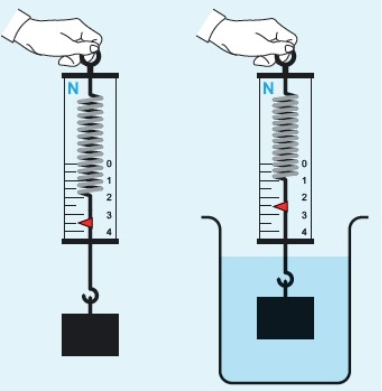
Fig. 1
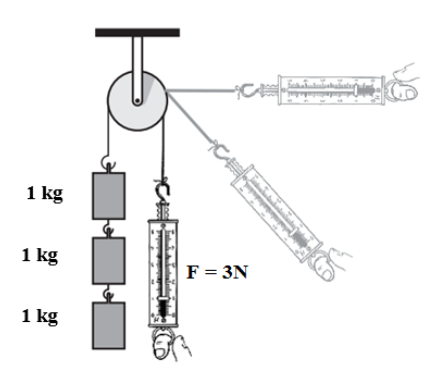
Fig. 2
Teacher: — In previous lessons, we studied levers. What is the purpose of levers?
Student: — Using a lever result in a gain in force or in a gain in distance.
Teacher: — Today we must find out whether a fixed pulley provides a gain in force. Conduct an experiment and compare the force required to lift a 200-gram load without using a pulley and the force required to lift the same load by applying a string over a fixed pulley. Students then independently determine the content and sequence of actions necessary to solve the problem.
Thus, frontal work takes on a creative nature. During frontal experiments, the teacher monitors each student's actions. Upon noticing a typical error or a common difficulty among multiple students, the teacher may pause the work for a moment and provide a general explanation or instructions to the entire class. Drawing conclusions and deriving conclusions are key aspects of conducting a frontal experiment. After students complete the practical portion of the frontal experiment, it is advisable to discuss their findings with them. The teacher corrects the findings, distinguishes between the essential and the unimportant, and encourages students to analyze and generalize their findings, identifying relevant patterns. In some cases, it is important to pay special attention to students' grades. Thus, when studying measuring instruments, it's helpful to have students mark a section of the scale and describe the procedure for determining the division value. This will encourage students to consider the scale's features and analyze them.
References:
1. Бугаев В. А. Методика преподавания физики в средней школе, Москва, Просвещение, 1981.
2. Малафеев Р. И. Проблемные обучение физики в средней школе, Москва, Просвещение, 2000.
3. Мастропас З. П., Синдеев Ю. Г. Физика: методика и практика преподавания. Ростов-на-Дону: Феникс, 2002.