Introduction
The ability to speak a foreign language fluently and appropriately remains one of the most challenging objectives for language learners. While traditional classroom instruction often prioritizes grammar and reading skills, modern educational paradigms emphasize communicative competence as the central goal of foreign language teaching. In this context, the use of video materials has gained increasing attention due to their capacity to simulate authentic communicative situations.
Video-based instruction provides learners with simultaneous access to linguistic input, paralinguistic features (intonation, stress, rhythm), and non-verbal cues such as facial expressions and gestures. According to multimedia learning theory, combining visual and auditory channels enhances comprehension and retention, particularly in language acquisition. Moreover, authentic videos expose learners to real-life language use, cultural norms, and pragmatic conventions, which are often absent from textbook-based instruction.
Research Design and Methodology
The study employed a quasi-experimental design conducted over one academic semester (15 weeks). Sixty undergraduate EFL students were divided into a control group and an experimental group, each consisting of 30 learners with comparable initial proficiency levels (B1 according to CEFR).
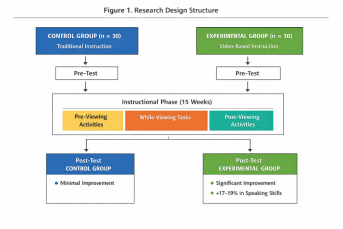
Fig. 1. Research Design Structure (Illustration of control vs. experimental groups and testing stages)
Stage 1: Pre-Viewing Stage — Preparatory Cognitive and Linguistic Activation
The pre-viewing stage plays a crucial role in preparing learners for meaningful interaction with video content. At this stage, instructional focus is placed on activating background knowledge, introducing key vocabulary, and reducing cognitive load during viewing.
Students engaged in:
– prediction tasks based on video titles or screenshots;
– guided discussion questions to stimulate interest;
Statistical observation revealed that learners who received structured pre-viewing activities demonstrated 12 % higher comprehension accuracy during subsequent speaking tasks compared to those without preparation
Stage 2: While-Viewing Stage — Interactive and Analytical Engagement
During the while-viewing stage, video materials are used as a dynamic linguistic input source. Videos included authentic interviews, short documentaries, and situational dialogues featuring native speakers.
Learners completed:
– focused listening tasks (identifying key ideas, discourse markers);
– repetition and shadowing exercises to practice pronunciation and intonation;
– guided pauses for immediate oral responses and clarification.
Quantitative results showed that learners exposed to repeated video viewing and shadowing activities improved pronunciation accuracy by 18 % and speech rhythm consistency by 16 % . These findings support the hypothesis that audiovisual input enhances phonological awareness and oral fluency more effectively than audio-only materials.
Stage 3: Post-Viewing Stage — Productive Speaking and Communicative Transfer
The post-viewing stage focuses on transforming receptive input into productive output. Learners engaged in role-plays, debates, summaries, and opinion-based discussions derived from video content.
Key activities included:
– reenacting dialogues with modified contexts;
– group discussions and problem-solving tasks;
– individual oral presentations based on video themes.
Post-test analysis demonstrated that students in the experimental group achieved an overall 19 % improvement in speaking performance , while the control group showed only a 6 % increase . The most significant gains were observed in fluency and discourse coherence, suggesting that video-based tasks facilitate natural speech production and idea organization.
Conclusion
This study demonstrates that systematic integration of video materials into foreign language instruction substantially improves speaking skills. By combining cognitive preparation, interactive viewing, and productive post-viewing tasks, educators can create an effective communicative learning environment. The proposed three-stage model offers a practical and adaptable framework suitable for secondary and higher education contexts. Future research may explore long-term retention effects and the role of learner-generated video content.
References:
- Mayer, R. E. (2021). Multimedia Learning. Cambridge University Press.
- Richards, J. C. (2015). Communicative Language Teaching Today. Cambridge University Press.
- Nation, I. S. P., & Newton, J. (2009). Teaching ESL/EFL Listening and Speaking. Routledge.